Running a commercial kitchen in Austin means managing a long list of operational requirements. One that operators cannot afford to overlook is the grease trap. Every restaurant, hotel kitchen, school cafeteria, and food service facility in the city is required to have a properly maintained grease interceptor, service it on a documented schedule, and keep the records to prove it.
Southwaste serves commercial kitchens of all sizes across Austin. Here is what grease trap service looks like in this market, what Austin Water requires, and what to expect when you call us.
Why Grease Traps Are Required in Austin
Grease traps and grease interceptors are designed to capture fats, oils, and grease (FOG) before they enter the municipal sewer system. FOG is one of the leading causes of sewer line blockages and overflows in Texas cities. When grease cools inside a sewer line it hardens, restricts flow, and eventually causes a blockage. That blockage can result in sewage backing up into restaurants, flowing into streets, or reaching local waterways.
Austin Water Utility operates a formal FOG management program that requires all commercial food service operators connected to the Austin sewer system to install, maintain, and regularly service grease interceptors. Austin Water inspectors conduct both scheduled and unannounced inspections, and operators who fail face fines, corrective action orders, and the potential for service suspension on repeat violations.
What Austin Water Requires
Austin Water enforces a FOG control program that applies to all commercial food service establishments in the city. Key requirements include:
Properly sized and installed interceptors. Austin Water reviews grease interceptor sizing during permitting and when a facility changes its operations or equipment. Under-sink traps are permitted in limited circumstances and must meet specific flow capacity requirements.
The 25 percent rule. Operators must pump before the combined depth of grease cap and settled solids reaches 25 percent of the interceptor’s liquid capacity. For most restaurants this means service every 30 to 90 days depending on kitchen volume, menu type, and interceptor size. The frequency that keeps you under 25 percent is the one you need to follow, regardless of what any standard schedule says.
Service manifests on file. Every pump-out must be performed by a registered hauler and documented with a manifest showing the date, volume removed, and disposal location. Austin Water cross-references hauler records against what operators report during inspections. Southwaste provides a complete manifest with every service call.
Self-monitoring logs. Operators are expected to maintain logs on-site and produce them during inspections. Austin Water inspectors also coordinate with Austin Public Health, which means a grease trap issue can surface during a routine restaurant inspection that has nothing to do with the wastewater utility.
What Grease Trap Service Includes
When Southwaste services a grease interceptor in Austin, here is what happens:
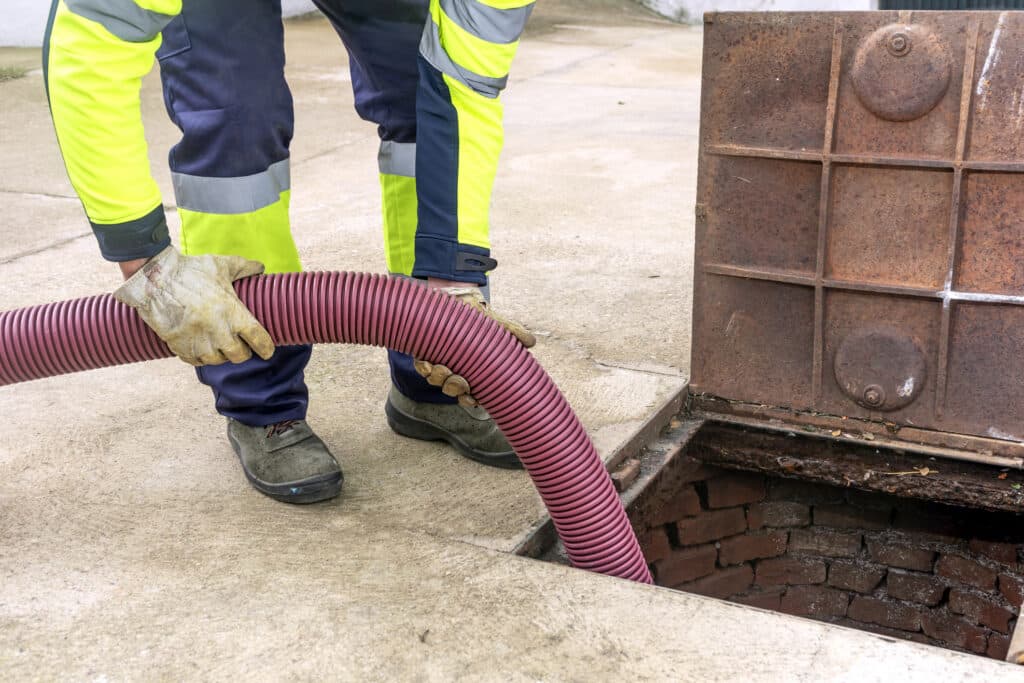
Full pump-out. We remove the full contents of the interceptor, including the grease cap and settled solids. Partial pump-outs leave behind the material most likely to cause problems and do not reset your compliance clock properly.
Scraping and rinsing. After the pump-out, we scrape and rinse the interior walls to remove accumulation that clings after a standard vacuum. This step extends the time before the interceptor reaches the 25 percent threshold again.
Condition check. We inspect the inlet and outlet baffles, the lid, and the visible interior for signs of damage or deterioration. If something needs attention, we note it and communicate it to you clearly.
Service manifest. You receive a completed manifest documenting the date, location, volume removed, and disposal method. Keep this on file. It is your proof of compliance when an Austin Water inspector shows up.
Optional hydrojetting. If there is grease buildup in the downstream lines beyond the interceptor, we can jet those lines during the same service call. This is common in older buildings, high-volume kitchens, and restaurants that have had inconsistent service histories.
We schedule at times that work for your kitchen, including early morning and after-hours windows that do not interfere with your service periods.
How Often Should You Be Serviced in Austin?
The honest answer is that it depends on your operation. The 25 percent rule is the governing standard, and the only way to know your specific frequency is to track your interceptor’s fill rate and establish a schedule based on actual data rather than a general rule of thumb.
A few factors that push frequency shorter: high-FOG menus like fried foods and BBQ, heavy disposer use, high-temperature dishwashing equipment, and smaller interceptors relative to kitchen volume. A few factors that allow longer intervals: low-FOG menus, larger interceptors, and good kitchen FOG practices like scraping plates and pans before rinsing.
Southwaste can help you establish a schedule that keeps you under the 25 percent threshold and in compliance with Austin Water’s program. If you are not sure where you stand, the fastest way to find out is to call us and let us assess your current setup.
New to Austin, or Just Getting Into Compliance?
If you are opening a new location, changing your kitchen operations, or taking over a facility that has been out of compliance, the time to establish a proper grease trap service program is before your first inspection, not after. Austin Water inspectors take documentation seriously, and starting from zero with incomplete records makes your first inspection harder than it needs to be.
Southwaste can walk you through what Austin Water requires, get your interceptor pumped and documented, and set you up with a service schedule that keeps you compliant going forward.
Why Call Southwaste for Grease Trap Service in Austin
We know Austin Water’s program, we document every service correctly, and we show up when we say we will. Our manifests meet Austin Water’s documentation standards, and our team communicates clearly when something on your interceptor needs attention beyond the standard service.
If your trap is overdue, your records are incomplete, or you are starting a new operation and need a compliant grease trap maintenance plan in place before your first inspection, give us a call. We will take it from there.